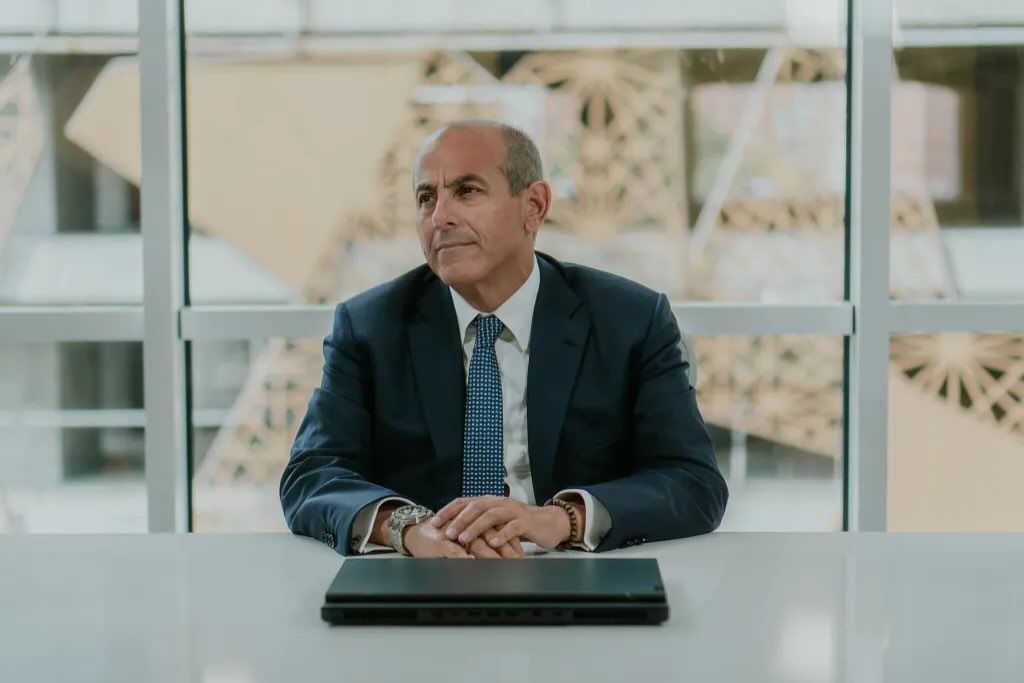
From his office in Caracas, José Simón Elarba Haddad runs an empire that blends garbage collection, banking, ties to senior Chavista power brokers, and a long trail of lawsuits piling up in Venezuelan courts. A lawyer by training, he turned public services and private institutions into platforms for economic and political power. He is an operator skilled at moving comfortably through the swamp of Venezuelan politics and business.
Born in Caracas on July 24, 1964, he earned his law degree from Universidad Santa María. His career began in corporate law, but he soon understood that the real business was not in legal briefs or boardrooms, but in public contracts, political favors, and closed-door concessions.
Before becoming the public face of Fospuca, the company that now monopolizes garbage collection in key municipalities in eastern Caracas, Elarba was already moving with ease through the corridors of the Supreme Tribunal of Justice. For years, he was pointed to as part of an informal network known as “Los Enanos”, a group of judges, lawyers, and operators dedicated to engineering “favorable” judicial decisions. That period, now conveniently buried beneath layers of entrepreneurial success, was his real school of power. It was there that he learned how impunity works in Venezuela.
The decisive leap came in 2014, when Elarba emerged as an intermediary for two Chinese technology giants: CEIEC and ZTE. Through his company Sylo Investments LTD, registered in the British Virgin Islands, he billed at least $28 million in “consulting services” aimed at facilitating contracts with Cantv and Movistar. Documents leaked in the Pandora Papers detail that these services included access to confidential information, internal budgets, and direct contacts within Venezuelan state institutions.
These were not minor clients. Reuters identified ZTE as a key player in the development of the Carnet de la Patria, the Chavista government’s social control platform. CEIEC, for its part, was sanctioned by the U.S. Treasury Department for collaborating in censorship and digital surveillance in Venezuela. To both, Elarba opened doors. In return, money flowed through accounts in Luxembourg, Panama, and Singapore. That same year, the U.S. Treasury’s FinCEN unit flagged a $1.48 million transfer to one of Elarba’s accounts with no apparent economic purpose.
With that capital, Elarba consolidated his local expansion. In December 2014, he acquired Fospuca, initially in partnership with Henry Jesús Camino Muñoz, the husband of his stepdaughter Mariana Flores Melo. What followed was a radical transformation: ironclad contracts, imposed fees, political pressure on municipal governments, and a narrative of “modernization” that concealed an extractive business model. Garbage became one of the most profitable businesses in Caracas, and Elarba its unofficial czar.
At first glance, it looks like a business success story. But residents of Chacao, Baruta, and El Hatillo know that Fospuca does more than collect waste: it imposes unaffordable fees, corners businesses, and enjoys an unusual level of institutional protection.
At the same time, Elarba maintained open relationships with central figures of Chavista finance. He publicly acknowledged his friendship with Carlos Erick Malpica Flores, former national treasurer and nephew of Cilia Flores, sanctioned by Panama and later rehabilitated. He has also been linked to Raúl Gorrín, sanctioned by the U.S. Office of Foreign Assets Control (OFAC). Today, José Simón Elarba is a frequent guest on programs aired by Globovisión, the television network owned by Gorrín.

That network of relationships explains why, despite repeated scandals, Elarba never falls. In Venezuela, it is not the most discreet who survive, but the best connected.
The next move was banking. After the PDVSA-Crypto scandal erupted—ending with the arrest of the De Grazia Suárez brothers—Bancamiga was exposed as a key intermediary in operations involving the Petro cryptocurrency. Far from being sidelined, the bank simply changed hands. Elarba emerged as its new shareholder and president, in what many interpret as a political rescue operation: those who serve the system do not pay the full cost of collapse.
In 2023, his name resurfaced forcefully following the seizure of Jefferson School in Valle Arriba, after the arrest of the Perdomo Rodríguez brothers on corruption charges. Witnesses claim that Elarba presented himself at the school as its new owner. To date, there is no public documentation supporting the transaction. But in today’s Venezuela, power does not always require paperwork. Elarba now openly lists himself—on résumés and social media—as president of the institution.
Judicial traces continue to emerge. Within the Supreme Tribunal of Justice alone, multiple cases link his name to abuse of dominant position, illegal charges, and opaque contractual practices. Rulings such as AP21-L-2022-000120 and R-2023-00010 reflect a recurring pattern: arbitrary service fees, violations of environmental regulations, and judicial harassment of those who challenge his interests.
His family and professional circle complete the picture. His wife, Aitza Melo Castillo, is a partner at Gadea, Lesseur & Asociados, the same firm where opposition figures such as Gerardo Blyde work—Blyde being a legal consultant for Fospuca after having served as mayor of Baruta, the very municipality that granted the garbage concession to the company he now advises. Formally described as a “cost-sharing partnership,” the firm in practice functions as another intersection point between political power, business interests, and legal shielding.
Former partners, such as Carlos Uzcátegui Valero, are linked to earlier waste management companies like CAUVICA, with records of inflated billing and unpaid labor liabilities.
Elarba was also a shareholder of the newspaper El Nacional. When the outlet was seized by court order at the request of Diosdado Cabello, he remained silent. Today, former executives of the newspaper work directly for him, closing the circle of transactional loyalties that defines his career. The most emblematic case is Jorge Makriniotis, son of Antonieta Jurado—partner of Miguel Henrique Otero—and former executive at El Nacional, now Elarba’s personal assistant.
The pattern repeats itself: courts, telecommunications, garbage, banking, education. Regulated sectors, opaque by nature, dependent on state favor. In all of them, Elarba appears not as a marginal actor, but as a central facilitator. Never the most visible face of power, but always present where decisions are made.
In public, Elarba presents himself as a philanthropist and a lover of sports and education. In private, he has become a symbol of a Venezuela where basic services are monopolies disguised as private companies, and where proximity to power is the best possible investment.
Whether it is banks, schools, or garbage, wherever there are rents guaranteed by the State or spaces protected by silence, his name appears. And behind it, a network woven from impunity, power, and millions.