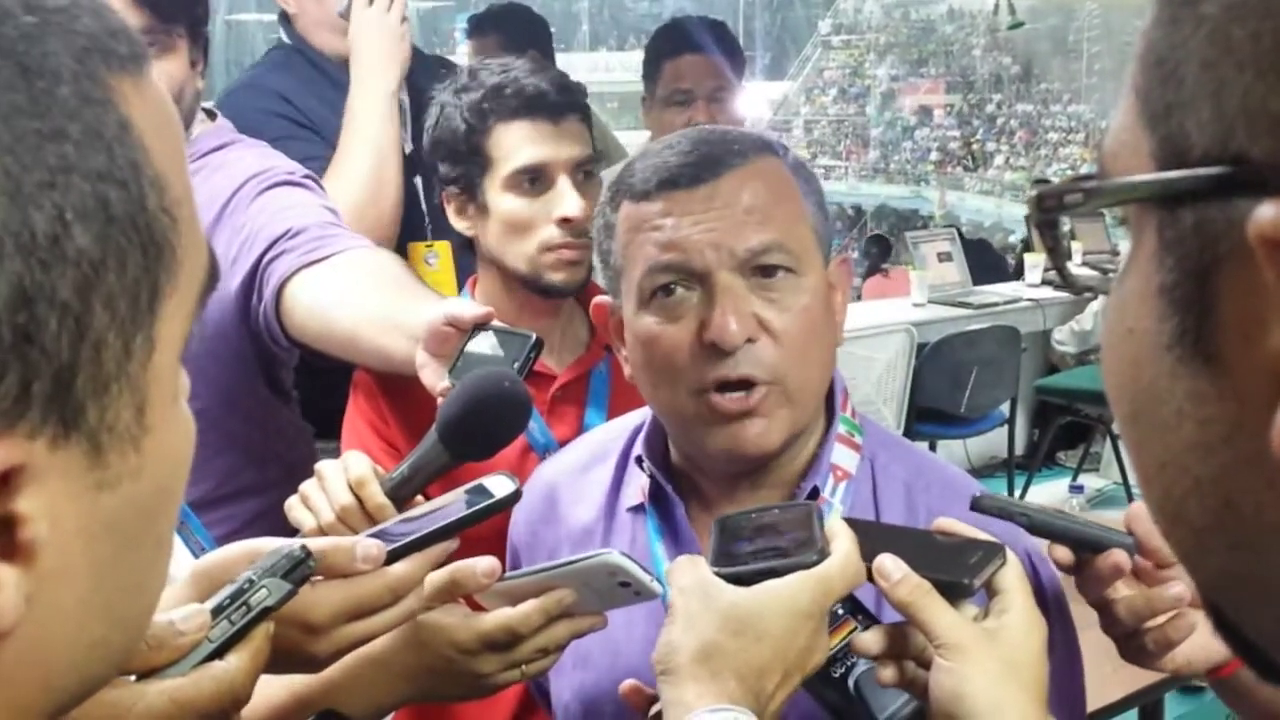
Carrero’s entry into Chávez’s political movement was linked to Luis Miquilena, one of Chavismo’s leading political operators during its early years. Miquilena, who played a decisive role in building the alliance that brought the former military officer to the presidency, reportedly introduced the businessman from Barinas to the future president’s inner circle. That relationship opened the door to other connections within the government.
Among the political figures close to Carrero were Pedro Carreño, who reportedly served as a political envoy and liaison, and General Raúl Isaías Baduel, one of the most influential military officers during the early years of the Bolivarian Revolution. His proximity to these figures placed the businessman in contact with both the civilian and military leadership of Chavismo. The relationship between Carrero and Chávez also had a personal dimension. Both came from Barinas, and various publications have described the businessman as a friend of the former president since their youth. That closeness survived the initial tensions between the government and some of the businessmen who had helped bring Chávez to power.
Journalist Nelson Bocaranda documented that relationship in a December 2009 social media post, referring to the trust Chávez continued to place in Carrero during the preceding regional election period. The observation is significant because it suggests that, at least according to the journalist’s account, the personal relationship between the two men remained intact years after the 1998 presidential campaign, even as disputes had already emerged between the businessman and government agencies.
Carrero Nácar’s financial beginnings were far removed from the traditional fortunes of Caracas. A biographical account published in 2019 identifies him as the son of a grocery store owner in Barinas and states that he began his professional career working for Grupo de Empresas Mendoza. He subsequently developed his career in the insurance industry, eventually becoming president and owner of Multinacional de Seguros, one of the most important companies in the Venezuelan market. His rise in business coincided with his growing proximity to political power.One of the first controversies surrounding his government contracts emerged just two days after Hugo Chávez took office on February 2, 1999. According to allegations documented in the available material, the Deposit Guarantee and Bank Protection Fund (Fogade) awarded Multinacional de Seguros an insurance policy covering the institution’s assets on February 4 of that year, for an amount exceeding four billion bolívares. The publication questioned whether the contract had been awarded directly without sufficient disclosure to Fogade’s board and noted that Multinacional de Seguros had outstanding obligations connected to Banco Latino.
Those allegations raised questions about possible preferential treatment for a company associated with one of the new president’s financiers, although the material reviewed does not include a court ruling establishing criminal responsibility for the award. Carrero’s relationship with Luis Miquilena also appears in journalistic investigations into the growth of Multinacional de Seguros. A Colombian publication from September 2025 maintained that Carrero obtained insurance contracts from various government agencies through his relationship with Chávez’s former mentor. However, the political rupture between Miquilena and the president in late 2001 reportedly weakened that privileged position over time. Despite those tensions, Carrero maintained a substantial economic presence during the Chávez years. Multinacional de Seguros continued operating in Venezuela, while the businessman diversified his investments into media outlets, agricultural properties, and professional sports organizations. One of the most significant business disputes of his career involved the Venezuelan Guayana Corporation (CVG) and its subsidiary CVG Venalum, a state-owned aluminum producer. In June 2011, journalist Carlos Herrera, director of Primicias24, announced a complaint against Carrero Nácar and Multinacional de Seguros over alleged fraud involving compensation for an industrial accident that occurred on November 16, 1998, at Venalum’s Line II electrolytic cell complex.
The controversy originated in an industrial risk insurance policy taken out in 1995 with Multinacional de Seguros, identified as policy number 20-01-082103, which involved the international reinsurer Lexington. According to the complaint, the incident caused damage exceeding $50 million, while loss-adjusting firm Crawford calculated the compensable losses at $37,516,296. The complainants maintained that Multinacional de Seguros refused to pay, relying on a clause that made compensation conditional on prior payment by the reinsurer. The legal dispute centered on that contractual provision, which the complainants considered contrary to Venezuelan insurance law. They also challenged the conduct of various judicial and administrative officials involved in the proceedings. Among those named in the allegations were Judge Zurima Fermín and the then-national insurance superintendent, Ana Teresa Ferri. The complainants questioned their decisions and actions, although the material collected does not establish that either woman was convicted of corruption or that the alleged bribery was proven. The dispute reached several judicial bodies, including the Political-Administrative Chamber of Venezuela’s Supreme Tribunal of Justice, where case number 2009-209 was handled. According to published accounts, the chamber was asked to take over the proceedings, and measures relating to the attachment of assets were ordered. The documentation provided does not establish the final outcome of all the claims. At the same time, Carrero maintained agricultural investments in his home state. Together with his wife, María Auxiliadora Valentiner de Carrero, he was identified as an owner of Hato Caroní, a cattle ranch located in the El Toreño area of Barinas municipality. In February 2009, the National Land Institute (INTI) initiated proceedings to recover the property. The businessman publicly opposed the intervention, arguing that the ranch complied with the legal requirements for agricultural production. Carrero maintained that the operation supported 1.44 head of cattle per hectare, above the average established by the authorities, and provided direct employment for more than 200 workers.
He also denied that the property was an unproductive large estate and challenged statements made by the then-president of INTI, Juan Carlos Loyo. The dispute reached the Supreme Tribunal of Justice. On May 31, 2011, its Special Agrarian Chamber declared proceedings relating to an appeal filed by Carrero and María Auxiliadora Valentiner terminated after more than a year had passed without procedural action by the appellants. The decision left standing the refusal to grant an interim measure they had requested against INTI’s actions. The confrontation over Hato Caroní demonstrates that tensions between Carrero and the Chávez government began before Nicolás Maduro came to power. Nevertheless, the deepest political rupture occurred during Maduro’s administration. The businessman also developed substantial interests in the media industry. He was identified as the majority shareholder of the weekly newspaper Quinto Día and has been associated with Circuito Radio Venezuela, a network of radio stations whose ownership various publications attributed to him. Among his most significant business partnerships was his association with journalist Alberto Federico Ravell Arreaza, a former Globovisión executive and founder of the news website La Patilla. Carrero and Ravell participated in media businesses in both Venezuela and Colombia. In Maracaibo, they were associated with the newspaper Versión Final, in a partnership that also included political leader and former Zulia governor Manuel Rosales Guerrero. Their business relationship extended to the Colombian television channel Cable Noticias. An investigation published in December 2019 maintained that Ravell, in partnership with Carrero Nácar, acquired the Bogotá-based broadcaster for approximately $17 million. The outlet had previously belonged to Colombian businessman Juan Gonzalo Ángel Restrepo, a former executive of the Medellín Sin Tugurios Foundation, an organization once chaired by Pablo Escobar Gaviria.
Carrero’s involvement in Cable Noticias connected him to Colombia’s news media industry, while his relationships with Venezuelan journalists strengthened his influence in political communications. Those relationships included his ties to Nelson Bocaranda, founder of Runrunes, who has been described as a recipient of financial support from the businessman. His personal connections with journalists Roland Carreño and Kico Bautista have also been mentioned. Although these relationships form part of the background material collected, no financial records are available to establish the extent of Carrero’s alleged contributions to Runrunes. His closeness to Alberto Federico Ravell eventually became a subject of public confrontation with Diosdado Cabello, one of Chavismo’s most prominent leaders. In September 2019, Cabello accused the businessman of promoting efforts to prevent Venezuela’s professional baseball season from taking place and of exercising influence over Ravell. During his television program Con el Mazo Dando, he blamed Carrero for pressure to move the championship to Miami and openly questioned the journalist’s independence from the businessman. Those statements illustrated how far Carrero had moved from being one of Chávez’s financial allies to becoming a target of attacks by the ruling political leadership. His relationship with Ravell also appears in publications concerning the administration of international resources allocated to the interim government led by Juan Guaidó. A December 2019 article claimed that both men participated in managing funds provided by the United States, through the United States Agency for International Development (USAID), to support journalists and media outlets aligned with Guaidó.
This remains a journalistic allegation requiring documentary corroboration. The available material contains no USAID records establishing that Carrero directly administered those funds or allowing their destination to be determined. The businessman’s involvement in media affairs was also recorded in a United States diplomatic cable. A cable from the US Embassy in Caracas describes a February 3 conversation with Carrero, identified as the owner and chief executive officer of Multinacional de Seguros. During the meeting, Carrero told a diplomatic official about pressure that, according to what Nelson Mezerhane had told him, the Venezuelan government was exerting on Globovisión and Banco Federal. The businessman claimed that the authorities wanted to change the channel’s editorial direction, remove programs such as Aló Ciudadano and Buenas Noches, and secure the departure of Alberto Federico Ravell and presenter Leopoldo Castillo. During that conversation, he also mentioned former Finance Minister Alí Rodríguez as a government interlocutor in negotiations involving Globovisión. The information is relevant because it places Carrero among those familiar with tensions between political power, media owners, and Venezuela’s financial sector. The cable records his account of events rather than independently confirming every instance of pressure he described. Professional sports became another major area of investment. In 2007, Carrero acquired the Bravos de Margarita franchise, a team in the Venezuelan Professional Baseball League (LVBP), turning the organization into one of his family group’s most visible sporting assets. Carrero’s involvement in baseball also had political consequences. In 2020, a report examining Chavismo’s influence over Venezuelan sports leagues stated that the businessman had been subject to an attachment order issued by the Supreme Tribunal of Justice and that an intervention board had taken over the administration of Bravos de Margarita. The episode represented another confrontation between Carrero and the Maduro government, this time involving a sports organization with significant economic and commercial interests. The family’s expansion into American baseball came in 2017, when it joined the investment group that acquired the Miami Marlins, a Major League Baseball franchise. The overall transaction, valued at $1.2 billion, was led by a consortium that included Bruce Sherman and former baseball player Derek Jeter. The Carrero family joined as a minority shareholder, although neither the exact ownership percentage acquired nor the amount of its individual investment was made public. Tobías Enrique Carrero Valentiner, the businessman’s son and vice president of Multinacional de Seguros, confirmed the family’s participation in an interview with Unión Radio Deportes in October 2017. He explained that the buyers were looking for partners with knowledge of the Latin American market and the baseball business. The family was represented at the official presentation of the Marlins’ new ownership group in Miami. In addition to Tobías Enrique, publications identify his brothers Luis and Rafael Carrero Valentiner as family members associated with the sports investment. The Carrero family’s international expansion was not limited to baseball. Rafael Carrero Valentiner, who studied at the University of Miami, has developed business interests in the financial and insurance sectors. According to a Colombian publication from September 2025, he serves as president of Impulse Finance, a company with offices in Puerto Rico specializing in financing, particularly insurance premiums. Rafael has also been linked to political controversies in Medellín during the administration of former mayor Daniel Quintero. Various Colombian publications, including reports attributed to IFM Noticias and Infobae, mentioned the influence Carrero Valentiner allegedly exercised within sectors of the municipal administration, particularly the Department of Education.
The allegations pointed to his relationship with Albert Corredor, a political figure he had known since their years studying in Miami. According to those publications, Corredor exerted influence over decisions within the Department of Education and was politically connected to Alexandra Agudelo, a former education secretary investigated in the scandal involving the Buen Comienzo program.
A business connection also links Agudelo to the Carrero family: in 2013, she worked as director of Social Development at Censa, an educational institution associated with the Carrero Valentiner family. The publications also mention requests by Medellín Mayor Federico Gutiérrez for US authorities to examine possible financial movements connected to Daniel Quintero. However, the allegations directed at Rafael Carrero do not establish any responsibility on the part of his father, Tobías Carrero Nácar, nor do they support a conclusion that both men participated in the alleged administrative irregularities. In Venezuela, one of the businessman’s most significant regulatory episodes occurred in November 2015. The Superintendency of Insurance Activity ordered the temporary closure of Multinacional de Seguros offices for 72 hours through administrative order FSAA-9-002346, published in Official Gazette number 40,783. The measure was adopted after the regulator determined that the company had accumulated more than five sanctions for violations of insurance regulations within a period of less than two years. In addition to the sanction imposed on the company, the authorities fined Tobías Carrero Nácar, Finance Vice President Bartolomé Ruggiero Imbriaco, and Vice President Carlos Moníz Rocha 4,500 tax units each, equivalent at the time to 675,000 bolívares. They also imposed a one-year prohibition on participating in insurance and reinsurance activities. Unlike other political accusations appearing throughout his career, this measure was an administrative action identified through an official order. Publications critical of the government interpreted the sanction as political retaliation against Carrero, whom the ruling party already considered close to opposition groups. That interpretation, however, does not negate the regulatory violations identified by the Superintendency or, by itself, establish that the decision amounted to persecution. Tensions with the government intensified in the following years. In May 2019, a publication identified Carrero and businessman Nelson Mezerhane as alleged financiers of the April 30 military uprising, when a group of military personnel mobilized alongside Juan Guaidó and Leopoldo López near La Carlota air base in Caracas. The account attributed contacts with US Senator Marco Rubio to both businessmen and alleged that they had financially supported the events. Nevertheless, the background material provided contains no banking records, judicial evidence, or ruling substantiating those accusations. Other allegations also circulated about a supposed plot against Nicolás Maduro that reportedly prompted the government’s intervention in the businessman’s properties. In April 2023, Nelson Bocaranda published a series of allegations concerning former lawmaker Hugbel Roa and his relationship with Tareck El Aissami, a former oil minister and former president of Petróleos de Venezuela (PDVSA). According to Bocaranda, after El Aissami assumed responsibilities at PDVSA, a mansion previously expropriated from Tobías Carrero by Maduro’s order was allegedly put to use. Carrero had been accused by the authorities of participating in a plan to overthrow the president. The journalist maintained that Hugbel Roa subsequently occupied the property and that works of art, furniture, equipment, and vehicles later disappeared from it. These claims form part of Bocaranda’s allegations and should not be confused with facts established in court. The account connected the use of the businessman’s property to controversies that later surrounded Roa and El Aissami in Venezuela’s oil industry, particularly in the context of corruption investigations involving PDVSA. Carrero has also maintained ties to other business and sports sectors outside Venezuela. A September 2023 publication identified him as the representative and license holder of an official Atlético de Madrid football academy in Panama, although that information requires direct confirmation regarding the ownership and current validity of the commercial rights.
In his personal life, various publications have mentioned a former romantic relationship with Gloria Pinho, a lawyer and former director of Prisons during Rafael Caldera’s second administration, who later became involved in Venezuela’s judicial and political affairs. In February 2010, a journalistic account recalled their relationship and noted that Pinho had maintained political ties to Luis Miquilena and Supreme Court Justice Eladio Aponte Aponte. The report also referred to her involvement in proceedings concerning journalist Leocenis García. Carrero’s family background is also connected to the Valentiner family, associated with major Venezuelan business interests.
His wife, María Auxiliadora Valentiner de Carrero, appears alongside him in the Hato Caroní court proceedings. An autobiographical publication from August 2025 identifies Guillermo Valentiner, founder of Laboratorios Vargas, as the father of a woman who married the businessman. The family also experienced incidents involving personal security. A report published in Spain in August 2009 stated that Carrero’s mother had been kidnapped in Barinas in 2005, during a period marked by threats and conflicts affecting his circle. The same article, published during a visit by the businessman to Vigo, reported that he had landed at Peinador Airport aboard a private Canadair CL-600 aircraft arriving from Geneva, Switzerland. The trip, undertaken with his wife, once again highlighted his financial resources and international travel. Carrero’s presence in Spain came at a time when he was already engaged in a public dispute with the Venezuelan government over the intervention at Hato Caroní. The Spanish press recalled his earlier financial support for Chávez’s election campaigns.
The relationship between the businessman and Chavismo eventually developed into an open political confrontation. During Maduro’s presidency, Diosdado Cabello repeatedly accused him of acting against the interests of Venezuelan baseball and of exercising influence over opposition media outlets. Among the most recent publications included in the collected material is an accusation by Cabello concerning Carrero’s alleged involvement in decisions by baseball leagues in the Dominican Republic, Puerto Rico, and Mexico regarding the 2026 Caribbean Series. The ruling-party leader attributed efforts to undermine the tournament’s staging in Venezuela to the businessman, without providing independent evidence of his involvement in the text.
Tobías Carrero Nácar’s career thus encompasses several stages of Venezuela’s political and business history. He was among the businessmen who financially supported Hugo Chávez’s rise, developed substantial insurance interests during the early years of his administration, maintained relationships with influential figures in government, and subsequently became associated with media outlets and political leaders opposed to Chavismo. His name appears in controversies involving government contracts, claims by state-owned companies, regulatory sanctions, land disputes, sports investments, and accusations of political conspiracy. Some of those proceedings are supported by identifiable case files and administrative decisions; others stem from journalistic allegations or statements by political leaders whose accuracy has not been established by the documentation reviewed. Carrero’s transformation from a financier and personal friend of Hugo Chávez into a businessman targeted by Nicolás Maduro’s government is central to a career shaped by access to political power, business dealings with the state, and eventual confrontation with those who inherited control of Venezuela’s political system. His story also leaves a fundamental question unanswered: precisely how much capital he contributed to Chávez’s political project, which contracts he obtained during those years, and how his business interests evolved after his break with Chavismo.