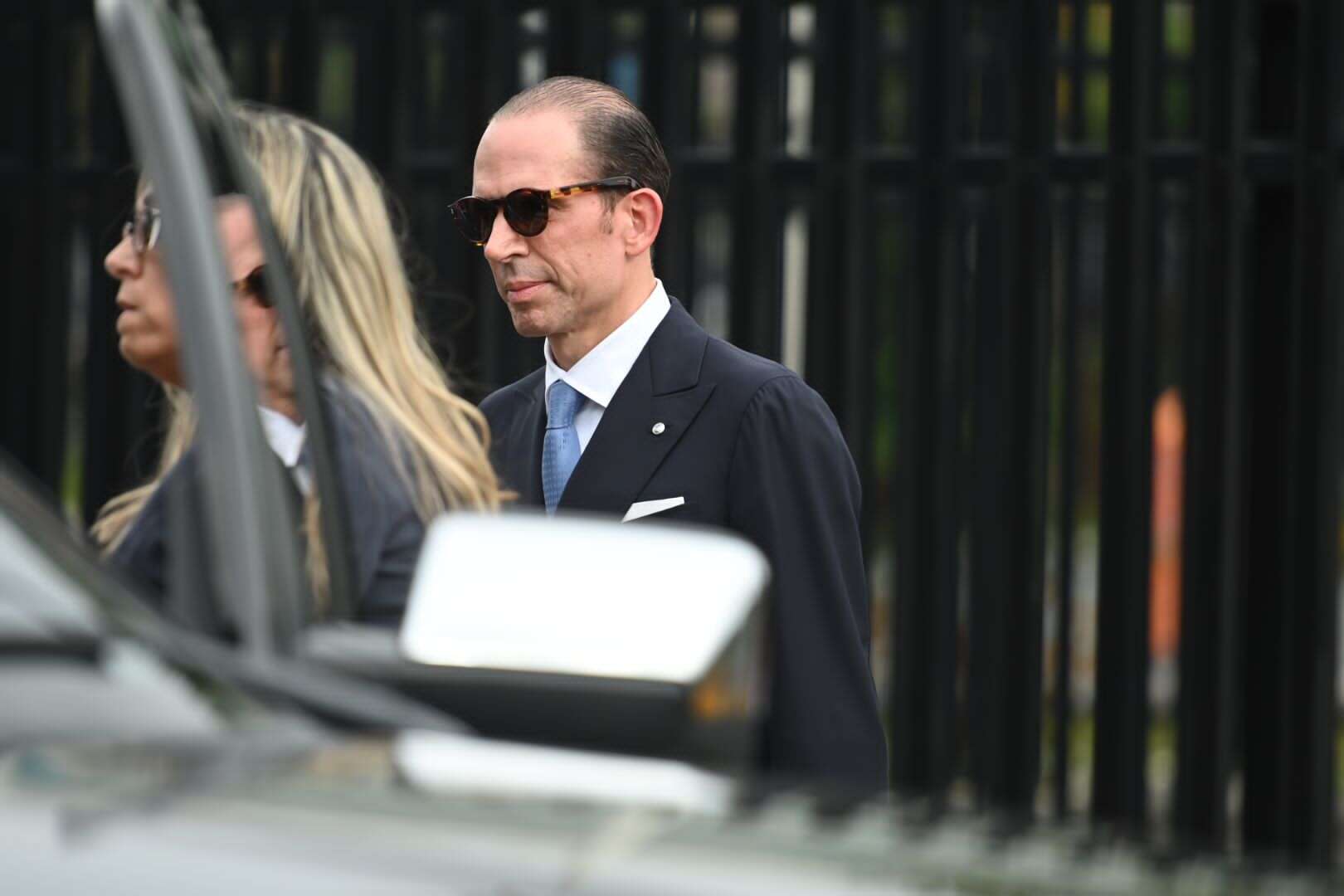
Julio Martín Herrera Velutini, also identified in various publications and historical records as
Julio Martín Herrera Kolster, has spent much of his career navigating the worlds of banking, financial companies, political influence, and legal controversy. His story began within one of
Venezuela’s traditional banking families, continued through the country’s 2009 financial crisis, and eventually led to a corruption scandal involving the government of Puerto Rico and, years later, the inner circle of U.S. President Donald Trump.
The latest chapter in that trajectory involves figures that are difficult to ignore: $3.5 million in political contributions made by his daughter, Isabela Herrera, to a committee affiliated with Trump; another $2.5 million pledged toward the construction of a White House ballroom; and a contract worth more than $50 million with Alina Habba, the president’s former personal attorney.
All of this unfolded while Herrera Velutini was seeking to escape the consequences of a federal criminal case involving an alleged bribery scheme intended to interfere with the supervision of his bank in Puerto Rico.
On January 15, 2026, Trump granted him a full and unconditional presidential pardon. The decision also benefited former Puerto Rico Governor Wanda Vázquez Garced and former FBI agent Mark Rossini, both involved in the same case.
Although journalistic investigations have not established that the financial contributions or Habba’s hiring determined the presidential pardon, the sequence of events has reignited debate over the influence of wealthy individuals on political decision-making in the United States.
A Fortune Built Around a Historic Family Name
Herrera Kolster was born in Caracas on December 15, 1971, according to the biographical accounts reviewed. His family background was connected to the Herrera Uslar and Velutini families, names associated with Venezuelan banking, investments, and business circles since the late nineteenth century.
For generations, the family
participated in the management of Banco Caracas, an institution that was eventually sold in 1998. That financial tradition became a central element of the banker’s public identity, and he has frequently presented himself as the heir to five generations of banking entrepreneurs.
However, his genealogy includes a particular detail highlighted by several publications: his branch of the family is connected to the Velutini lineage through adoption.
According to family histories published in the Venezuelan press, José Herrera Uslar and Clementina Velutini adopted three siblings in Europe who later settled in Caracas. One of them was Julio Herrera Velutini, the banker’s father.
For that reason, some investigations have questioned how the businessman presents his direct ancestry in relation to certain historical members of the family.
The other surname in his history, Kolster, is also associated with a criminal case.
His mother, Gilda Kolster, was sentenced in 2001 to 30 years in prison for her role as the mastermind behind the murder of her husband, Casto Martínez Garrido, in December 1996, according to the judicial accounts provided.
Several journalistic reports maintain that the banker, previously identified as Julio Martín Herrera Kolster, began using the surname Velutini instead of his maternal surname.
The reasons for that change have not been conclusively documented. Some publications associate it with the scandal involving his mother, while others suggest it may have been connected to his subsequent financial controversies. Neither interpretation establishes a definitive motive.
What is clear is that Herrera Velutini made his family identity and its associated banking tradition central elements of his international public image.
Banco Real: The First Major Financial Scandal
Before establishing himself in Puerto Rico and the United Kingdom, Herrera Velutini developed his business interests in Venezuela.
According to his corporate biographies, he began his career in Caracas’s securities market, worked at Multinvest Casa de Bolsa, and later became involved in companies such as Transbanca, Bolívar Banco, and Financiera Venezolana.
One of his most significant ventures was the acquisition of Banco de Desarrollo del Microempresario, a financial institution that eventually operated under the name Banco Real.
An October 2007 report by Reporte Diario de la Economía, reproduced in the reference materials, questioned the bank’s financial structure.
According to that report, only 22% of its assets were allocated to loans, while a substantial portion was invested in securities. It also stated that 72% of public deposits came from government entities.
If accurate, those figures indicated that the bank depended heavily on public-sector funds, despite having originally been established to finance small businesses.
Those concerns became more significant as Herrera Velutini pursued transactions intended to expand his presence in Venezuela’s banking system.
His plans included acquiring Helm Bank and negotiating the purchase of Banco Nacional de Crédito, owned by the group led by José María Nogueroles. According to published accounts, the objective was to consolidate several institutions into a larger banking organization.
But the project never materialized.
In December 2009, during a financial crisis affecting several Venezuelan institutions, the country’s banking regulator intervened in Banco Real. Helm Bank was also affected by government regulatory action.
The intervention occurred amid concerns about liquidity, asset composition, and compliance with banking regulations.
Herrera Velutini was summoned by Venezuelan prosecutors but was already outside the country, according to contemporary reports. Several accounts also mention an international search request that was subsequently withdrawn.
The banker has rejected the allegations made against him in Venezuela, maintaining that the proceedings were politically motivated.
His departure from the country, however, did not mark the end of his financial activities. Instead, it opened a new international chapter.
Puerto Rico: The Bank That Came Under Federal Investigation
Herrera Velutini founded Bancrédito International Bank & Trust in Puerto Rico in 2008, before Venezuela’s banking crisis erupted.
The institution operated under the island’s international banking framework, designed to facilitate certain cross-border financial services.
Over time, Bancrédito attracted the attention of Puerto Rico’s Office of the Commissioner of Financial Institutions (OCIF), the agency responsible for supervising the financial sector.
Regulators examined the bank’s financial operations and compliance deficiencies. Some Puerto Rican publications also raised suspicions about possible transactions involving businesspeople connected to the Venezuelan government, although the available sources do not establish that Bancrédito laundered funds for those clients.
The administrative investigation triggered the episode that would eventually bring Herrera Velutini before U.S. federal prosecutors.
According to the indictment filed in August 2022, the banker
participated in a scheme to provide financial support for then-Governor Wanda Vázquez Garced’s reelection campaign in exchange for her intervention in the leadership of the agency supervising his bank.
The official they allegedly wanted removed was George Joyner, then head of the OCIF.
Federal prosecutors maintained that Herrera Velutini sought to replace him with someone more favorable to his interests and bring regulatory scrutiny of Bancrédito to an end.
The case also involved Frances Díaz, who was connected to the bank’s management; John Blakeman, a political adviser to Vázquez; and Mark Rossini, a former FBI agent working as a private consultant.
The indictment described political financing arrangements, payments to consultants, and efforts to influence the appointment of the banking regulator.
The case was particularly significant because it did not merely involve a businessman seeking government contracts. Prosecutors alleged that he was attempting to influence the very authority responsible for supervising his own financial institution.
What the Court Proceedings Established
In August 2025, the case took a decisive turn.
After years of litigation, the serious charges were replaced through a plea agreement with a misdemeanor offense involving campaign contributions by a foreign national.
Herrera Velutini pleaded guilty to that lesser offense.
A document filed by federal prosecutors in October 2025 is particularly relevant because it outlines the facts and motivations presented during the proceedings.
According to the filing, Herrera Velutini sought to gain Wanda Vázquez’s favor through political contributions, with objectives that included ending an audit of Bancrédito and securing the appointment of Víctor Rodríguez Bonilla to lead the OCIF.
The case also described the commissioning of public-opinion research and mechanisms used to finance electoral activities.
The reduction of the charges prompted judicial scrutiny. Federal Judge Silvia Carreño Coll expressed reservations about the relatively lenient proposed penalty compared with the seriousness of the original allegations.
The agreement prevented the case from proceeding to trial on the more serious charges initially brought.
Nevertheless, the guilty plea to the campaign finance misdemeanor and the documentation entered into the proceedings established conduct aimed at obtaining favorable treatment from the agency responsible for supervising Bancrédito.
London: Financial Businesses and Political Donations
While his legal troubles unfolded in Puerto Rico, Herrera Velutini had developed a substantial business presence in the United Kingdom.
Among the companies associated with his career is Britannia Financial Group, a London-based financial services group.
His expansion into Britain was accompanied by political connections and donations to the Conservative Party.
Investigations by outlets including The Guardian and the BBC, cited in the reference materials, reported contributions totaling approximately £500,000 to the party.
Conservative representatives maintained that the donations had been properly declared and complied with electoral regulations.
The controversy extended beyond the formal legality of those contributions. Questions also emerged about the political access that major donors might obtain through their financial relationships.
That pattern took on a new dimension when Herrera Velutini shifted his efforts toward the American political establishment.
From Corruption Defendant to Presidential Pardon Recipient
Following Donald Trump’s return to the White House in January 2025, Herrera Velutini’s legal situation began to change.
In August of that year, the banker
reached the agreement that reduced the serious charges to a campaign finance misdemeanor. But according to an investigation published by The New York Times on October 20, 2026, he was still seeking a complete presidential pardon.
He was represented by attorney Christopher Kise, who had also served on Trump’s legal team.
Meanwhile, his daughter Isabela Herrera made contributions totaling $3.5 million to MAGA Inc., a political action committee supporting the president.
The contributions attracted the attention of Campaign Legal Center, an organization specializing in election law, which filed a complaint with the Federal Election Commission.
The organization requested an examination of whether Isabela Herrera had acted as a conduit for her father, whose status as a foreign national restricted his ability to make certain political contributions.
The complaint does not constitute a finding of wrongdoing. Based on the information available, no final ruling establishing that allegation has been documented.
However, the political contributions represented only part of the financial commitments surrounding the case.
Another $2.5 Million for Trump’s White House Ballroom
On October 15, 2026, The Washington Post published an investigation based on internal fundraising documents for the White House ballroom project promoted by Trump.
Isabela Herrera was among the donors identified.
According to records obtained by the newspaper, the banker’s daughter pledged $2.5 million to the project on September 23, 2025.
On October 14 of that year, she made an initial payment of $835,000.
The contribution came after her father’s plea agreement but before he received his presidential pardon.
The newspaper’s investigation identified approximately $333 million in private pledges for the project and examined the presence of donors with financial or regulatory interests before the administration.
The newspaper made clear that its findings did not establish that the contributions had led to favorable government decisions.
In Herrera’s case, the timing became even more significant when another multimillion-dollar arrangement emerged.
A Contract Worth More Than $50 Million With Trump’s Former Attorney
The investigation published by The New York Times on October 20, 2026, revealed that the
Herrera family had arranged to hire Alina Habba, Donald Trump’s former personal attorney and a figure close to his administration.
The hiring was carried out through Concord Partners, a company established in Florida by Isabela Herrera in October 2025.
The contract provided for annual compensation of $10 million over four years, plus bonuses that brought the guaranteed compensation to more than $50 million.
Habba would serve as the company’s chief legal adviser.
One particularly striking aspect was that, according to the investigation, Concord Partners had no publicly defined business activity that clearly explained the scale of the hiring arrangement.
The agreement was negotiated while Habba still held responsibilities within the U.S. Department of Justice.
The attorney formally began working with Concord Partners on January 1, 2026.
Fourteen days later, Trump pardoned Herrera Velutini.
Habba denied having participated in efforts to secure the presidential pardon. She also maintained that her private employment arrangement had been reviewed under the applicable rules.
The White House rejected any suggestion that the contract had influenced Trump’s decision, while the Department of Justice stated that Habba had not participated in discussions concerning the pardon.
The journalistic investigation did not establish that the contract constituted compensation in exchange for presidential clemency.
The sequence nevertheless brings together three documented events: an extraordinarily lucrative contract involving someone close to the president, multimillion-dollar political contributions from the applicant’s family, and a presidential pardon granted shortly afterward.
The Presidential Pardon That Ended the Criminal Case
On January 15, 2026, Donald Trump signed a full and unconditional pardon for Julio Martín Herrera Velutini.
The official clemency document expressly identifies the banker and the federal proceedings involving Wanda Vázquez Garced.
The decision also covered Vázquez and Rossini.
The White House defended the pardons by arguing that the prosecutions had been politically motivated.
The presidential pardon ended the federal criminal consequences covered by the measure. It did not, however, mean that a court had determined that all the original allegations were false.
Nor did it resolve the questions raised by investigations into the financial relationships between his family and individuals close to presidential power.
The Family Name, the Banks, and Access to Political Power
Herrera Velutini’s career
reveals a recurring theme across three different settings.
In Venezuela, his banking activities became entangled in the 2009 financial crisis and regulatory proceedings.
In Puerto Rico, the supervision of Bancrédito led to a federal case documenting unlawful campaign contributions and efforts to secure favorable treatment from the agency responsible for overseeing the institution.
In the United States, while seeking to close that legal chapter permanently, his family made multimillion-dollar political contributions and hired a former attorney to the president under an agreement worth more than $50 million.
These were separate episodes governed by different legal frameworks. They do not establish that all his business activities formed part of a single criminal scheme. They do, however, explain why his career has repeatedly attracted scrutiny over the relationship between financial business, banking regulation, and political influence.
Herrera Velutini has rejected various allegations throughout his career and challenged the motivations behind some proceedings against him.
His presidential pardon is an established fact. So are the 2022 federal indictment, the 2025 plea agreement, and the financial contributions documented by American news organizations.
The question that remains unanswered is not whether Trump had the constitutional authority to pardon him, but what role the political and financial relationships surrounding that decision may have played.
For a banker who began his career carrying one of the most recognizable names in Venezuelan finance, the outcome is significant: after years of regulatory and judicial controversy, his American criminal case ended not with an acquittal at trial, but with a personal decision by the president of the United States.