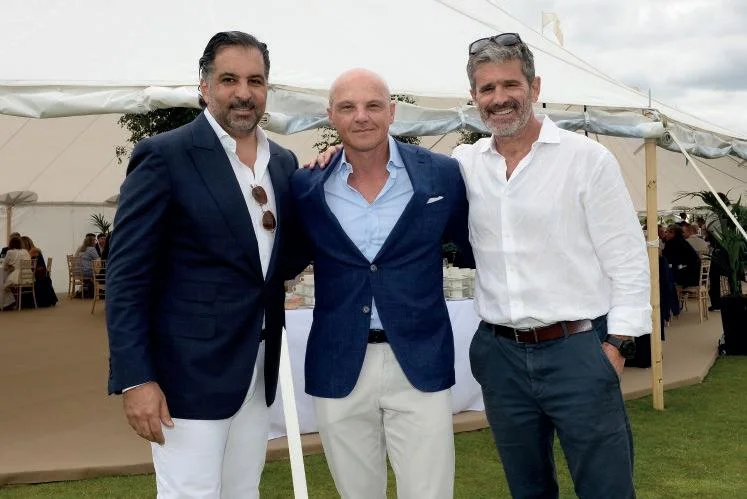
For four years, Alessandro Bazzoni was one of the most discreet yet active figures in the Venezuelan chavista network that evaded international oil sanctions. This Italian businessman, born on July 9, 1971, in Milan and currently residing in London, operated as a key piece of the network that enabled PDVSA to move crude oil outside the formal financial system, in alliance with operators such as Joaquín Leal Jiménez and José Luis Chávez Calva, both investigated in the United States for money laundering and conspiracy.
Bazzoni was sanctioned in January 2021 by the U.S. Department of the Treasury as part of the crackdown on the network tied to Tareck El Aissami, inheriting the role vacated by Alex Saab after his arrest in Cape Verde. According to the Treasury, he helped sell Venezuelan oil through shell companies and triangulated schemes involving countries such as Iran and Turkey. In January 2025, in one of its final actions before leaving the White House, the Joe Biden administration lifted sanctions against him amid ongoing energy negotiations.
From Mexico to Caracas: The Link with Joaquín Leal and Chávez Calva
During the toughest years of the pandemic, Bazzoni and his wife, the Norwegian Siri Evjemo‑Nysveen, temporarily relocated to Mexico, where they strengthened ties with Joaquín Leal Jiménez, a Mexican operator sanctioned for his role in the fraudulent CLAP food box business and other schemes tied to chavismo. Leal — who falsely claimed to be related to Mexican President Andrés Manuel López Obrador — became a key partner for Bazzoni, with whom he built a transnational crude oil marketing network, using Colonel José Antonio Pérez Suárez (then Vice President of Commerce and Supply at PDVSA, now detained) and minister Wilmar Castro Soteldo as intermediaries.
José Luis Chávez Calva, a former Mexican energy official, was also part of this ring as a technical and regulatory facilitator. His role was crucial in triangulating deals with Asian companies to place Venezuelan crude into sanctioned markets.
The Role of Siri Evjemo‑Nysveen and MBaer Merchant Bank
Behind Bazzoni’s financial apparatus was his wife, Siri Evjemo‑Nysveen, who in 2020 was appointed to the board of the Swiss bank MBaer Merchant Bank, a private banking institution controlled by the great‑grandson of the founder of Julius Baer. From that position, Siri facilitated the opening of Swiss bank accounts for Venezuelan officials and chavista operators, as well as the channeling of funds from Asia via Dubai and through the subsidiary Baer Capital Partners.
The couple used Norge Oil Limited, registered in the Isle of Man, to move funds derived from crude oil sales. In 2023, just as the corruption scandal that toppled El Aissami broke open, Siri was quietly removed from the bank’s board of directors.
Football as a Facade: SPAL and the Italian Trail
Bazzoni’s name also appears in the sports world. His brother, Lorenzo Bazzoni, is an executive at the Italian football club SPAL, based in the city of Ferrara. Although the acquisition was led publicly by attorney Joe Tacopina — known for being part of Donald Trump’s legal team — Tacopina admitted that a “top‑secret Italian family” was behind the financing. Lorenzo was identified as the representative of that family.
The purchase of SPAL, a club with over a century of history, raised suspicion among financial authorities due to the frequent use of football clubs as tools for money laundering. Investments totaling more than €25 million are under scrutiny by U.S. federal and European agencies.
Passion for Polo and Elite Circuits
Beyond football, Bazzoni and Siri share another passion: polo. They have competed in tournaments in Argentina, the United States, Italy, and the United Kingdom with their teams — Monterosso Polo Team and MT Vikings. This sport, traditionally associated with financial elites, has been used by sanctioned figures as a social platform and a laundering tool. Specifically, the Bazzoni–Evjemo‑Nysveen couple is under investigation in the U.K. for acquiring dozens of high‑value competition horses with money alleged to come from Venezuelan corruption.
The couple’s lifestyle includes properties in London, the Italian coast, and tax havens, as well as luxury vehicles, helicopters, and private jets. According to judicial sources, they use companies registered in Dubai, Switzerland, and the Caribbean to manage their assets without leaving obvious traces.
Rivalries: Saab and Jorge Andrés Giménez Ochoa
Although they coexisted for a period, Bazzoni and Alex Saab eventually became direct rivals in the crude and subsidized food business. While Saab controlled much of the CLAP supply chain and contracts with Iran, Bazzoni quietly advanced in more technical and sophisticated markets. The two clashed over routes, contracts, and preferred operators.
A similar rivalry developed with Jorge Andrés Giménez Ochoa, president of the Venezuelan Football Federation (FVF) and a trusted operator close to Tareck El Aissami. Giménez sought to consolidate logistical routes through Turkey, while Bazzoni developed his own network supported by European businessmen. The battle for market share in sanctioned petroleum fragmented logistical and placement networks tied to Venezuelan crude.
Ongoing Investigations
At least two U.S. federal prosecutor’s offices — the Southern District of Florida and the Southern District of Texas — are actively investigating Bazzoni’s role in the PDVSA embezzlement schemes. In Venezuela, the Attorney General’s Office has also issued an arrest warrant against him, linking him to crimes including trafficking of strategic materials, illicit commerce, and money laundering.
The Bazzoni–Evjemo‑Nysveen network is believed to be implicated in the misappropriation of more than $800 million, in a scheme that not only stripped Venezuela of vital petroleum resources but also contributed to the collapse of its food industry by involving producers as financial fronts.