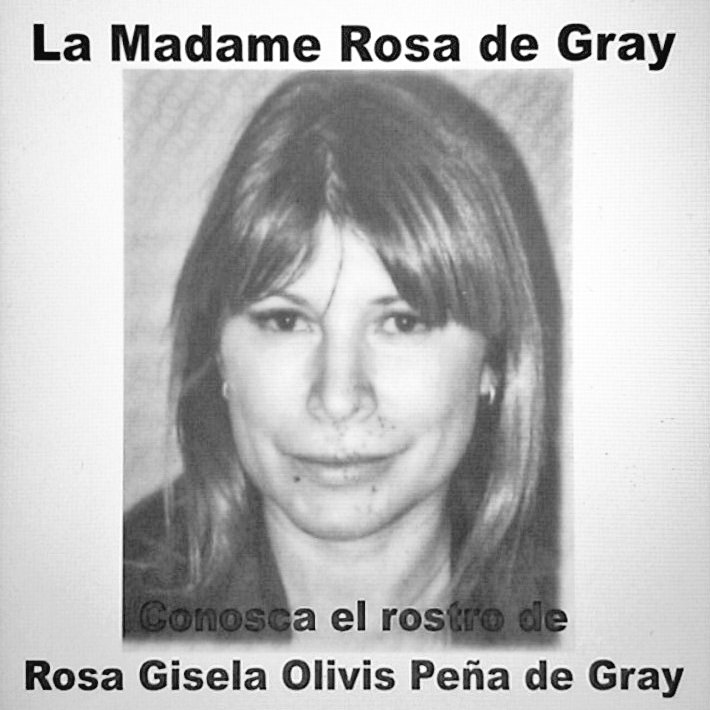
In the discreet corners of Venezuelan power — where state contracts are negotiated off-record and far from cameras — the name Rosa Gisela Olivis Peña de Gray surfaces with uncanny consistency. Not as a public figure or political spokesperson, but as a strategic link in a corporate network that has transformed political proximity into financial opportunity.
Married to Australian businessman Clifford Ross Gray, Olivis has spent years crafting a business architecture that spans Venezuela, Panama, the United States, and Spain. Publicly, she’s often introduced as the president of the foundation Huellas de Bondad, officially dedicated to social work. But behind that philanthropic façade lies a far more complex corporate operation.
In Panama, she’s listed as a director of multiple companies, including Latimex Corporation S.A., JM Mercantil Supply Inc., and Corporation Visloy S.A. These firms bear hallmarks of typical Chavista-linked structures: minimal visible activity, shared addresses, and ties to Venezuelan state contractors. In Venezuela, Olivis co-founded Corporación Graysam C.A., a company authorized by Nicolás Maduro’s government to import and distribute uniforms, industrial clothing, and equipment — primarily for military and security entities.
Graysam operated alongside a tight-knit group of associates and proxies whose names reappear across multiple companies: Yanori Bernal Vargas, Ámbar Yohana Quiroga Mata, Roda Saab Ganam, and Félix Ramón Hernández. Together, they appear linked to businesses such as Representaciones Felther, Lanzallamas 12 R.L., Inversiones Villaber, and Venservice — all of which have secured contracts from agencies like INCE Militar, IPSFA, Bolipuertos, the Foreign Ministry, Chavista-aligned mayors’ offices, and even government social programs like Misión Madres del Barrio.
The blueprint is clear: short-lived companies, no-bid or limited tenders, and a constant stream of public funds with little oversight — a recurring pattern within Venezuela’s “Bolivarian” business elite.
Olivis’ strategy also included moving capital abroad. In 2014, she purchased a luxury penthouse in Madrid’s exclusive Salamanca district for approximately €455,000, using a Miami-based bank account. It wasn’t an isolated case: others in her inner circle acquired properties in the same building through offshore firms based in Panama and Barbados, following a familiar laundering structure used by Chavista operators to convert public money into foreign real estate.
Her story also intersects with that of Samantha Gray Quintero, a former Chacao mayoral candidate who later gained attention for the €47 million acquisition of a prime Madrid building. Far from being just a daughter-in-law, Gray has been a close business partner. In a 2008 interview, Samantha confirmed that Olivis had introduced her to Clifford Gray, who later became her husband. Since then, Olivis and Samantha have co-founded at least four companies. Olivis has described her as a daughter, friend, and confidant.
Scandal has not been far from this circle. Unverified sources have linked Olivis to General Giuseppe Yoffreda Yorio, former head of Corpovex, in alleged schemes involving the recruitment of young women from schools and universities. While these claims have not been proven in court, their persistence in leaked reports and political dossiers speaks to the shroud of secrecy around the group.
Additionally, Olivis has been loosely tied to Turpial Airlines, a Venezuelan carrier that allegedly took advantage of the departure of major airlines to operate strategic routes through third countries like Curaçao, Panama, and Barbados — serving a niche market of government-linked elites.
With Venezuelan nationality, access to global banking systems, and companies spanning at least three countries, Rosa Gisela Olivis Peña de Gray exemplifies the modern Bolivarian business elite: low-profile, high-impact, and deeply embedded in the machinery of the state. She avoids the spotlight — but remains at the center of the deal.
Ver esta publicación en Instagram